When selecting timber materials for wet residential zones, understanding the difference between marine plywood vs BWP plywood Goa is the difference between a kitchen that stays rock-solid for 25 years and one that rots away behind expensive acrylic shutters. In South Goa's coastal belt—from Margao to Vasco, Colva, and Curchorem—indoor moisture is not a temporary inconvenience; it is an active four-month deluge where warm salt air accelerates adhesive breakdown.
Many timber dealers casually label both boards as "waterproof," leaving homeowners bewildered about why one sheet costs ₹85 per sq.ft while another costs ₹140. As a working carpenter with 21+ years on Goa job sites, I can assure you that IS:710 Marine Grade and IS:303 BWP are engineered for very distinct moisture exposure levels. Let us examine the technical facts and real-world recommendations.
1. Indian Standards Decoded: IS:710 vs IS:303
The Bureau of Indian Standards (BIS) regulates plywood manufacturing through two distinct certification benchmarks:
- IS:710 Marine Plywood: Specifically formulated for marine applications like boat building, structural coastal decking, and prolonged water submersion. It requires 100% selected hardwood veneers (such as Gurjan or Eucalyptus) and undiluted, unextended Phenol Formaldehyde (PF) synthetic resin.
- IS:303 BWP / BWR (Boiling Water Resistant): Formulated for interior and exterior furniture exposed to high ambient humidity, steam, and periodic water splashes. It also uses phenolic adhesive, but allows a wider variety of plantation timbers and requires a less rigorous boiling endurance test.
2. The 72-Hour Boiling Water Test Difference
The scientific differentiator between these two grades is the laboratory cyclic boiling test:
- IS:710 Marine Grade: Test samples must be submerged in boiling water (100°C) continuously for 72 hours. After 72 hours of thermal and moisture torture, the sample must show zero delamination of veneers, and its glue shear strength must exceed 1000 Newtons.
- IS:303 BWR / BWP Grade: Must withstand boiling water for 8 hours, followed by drying at 65°C for 16 hours, repeated across three cycles.
In a Goan kitchen where plumbing joints can develop slow hidden drips beneath sink basins, 72-hour marine bonding ensures that submerged wood plies never separate.
3. Hardwood Core vs Mixed Species Veneers
Plywood strength is not just about the adhesive; it is about the density of the wood layers pressed inside the sandwich:
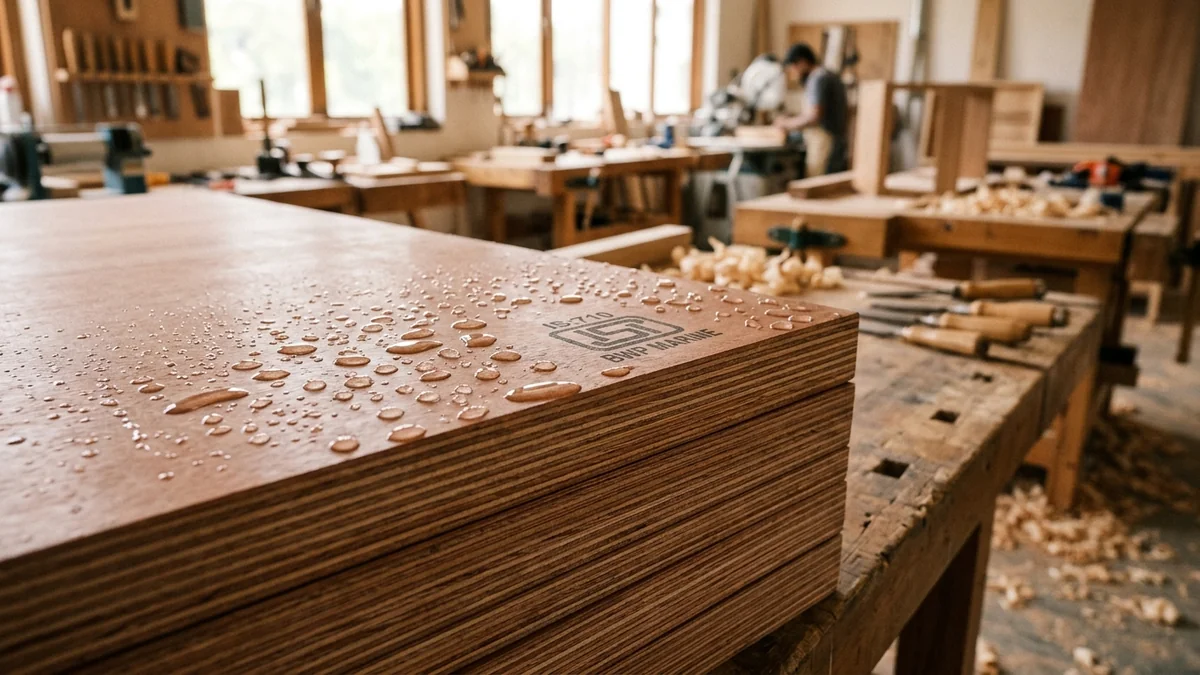
- Genuine Marine Plywood: Uses uniform 1.5mm to 2mm calibrated hardwood core veneers throughout. There are zero overlapping gaps, core splits, or voids inside the board. When you drive a screw into the side edge of a marine ply carcass, the screw bites into dense hardwood fibers without splitting the layers.
- Standard BWP Plywood: Frequently uses alternating plies of hardwood and lighter plantation timbers (such as Poplar or Melia dubia). While structurally adequate for bedroom wardrobes and wall lofts, its density is lighter, meaning it has slightly lower screw-holding retention over long decades.
4. Direct Comparison: Marine Plywood vs BWP Plywood Goa
| Specification / Factor | IS:710 Marine Plywood | IS:303 BWP / BWR Plywood |
|---|---|---|
| Boiling Water Resistance | 72 Continuous Hours (Zero delamination) | 8 Hours Boiling (Cyclic test) |
| Veneer Core Species | 100% Selected Heavy Hardwood (Gurjan/Eucalyptus) | Hardwood face with mixed plantation core |
| Adhesive Type | Unextended Phenol Formaldehyde (B-stage resin) | Fortified Phenol Formaldehyde Resin |
| Approximate Cost (18mm) | ₹115 – ₹160 per sq. ft | ₹80 – ₹115 per sq. ft |
| Termite & Borer Protection | Vacuum-pressure CCB impregnated | Chemical glue line treatment |
| Ideal Zone Application | Kitchen sink base, bathroom vanities, external eaves | Kitchen overhead lofts, bedroom wardrobes, study tables |
5. The Smart Budget Allocation Strategy
Do you need to build your entire Goan home out of expensive IS:710 Marine Plywood? Absolutely not. A sensible master carpenter uses a hybrid material allocation to optimize your budget without sacrificing water safety:
- Under-Counter Kitchen Sink & RO Unit: Must be 100% IS:710 Marine Plywood. When water filters leak or drain pipes back up, this area gets soaked. Marine ply ensures your cabinet will never swell or rot.
- Kitchen Overhead Cabinets & Tall Units: Use IS:303 BWR Plywood. Overhead lofts face cooking steam and heat, which BWR handles effortlessly at a 30% lower material price point.
- Bathroom Vanity Cabinets: Use IS:710 Marine Plywood. Bathrooms in South Goa have high condensation and daily floor splashing. Pair with PVC legs to lift the wood 100mm off the tiled floor.
- Bedroom Wardrobes & Bookcases: Use IS:303 BWR Plywood for internal shelving and drawers, reserving Marine Ply only for the back panel if it touches an exterior wall prone to dampness. Read our best wood for wardrobes guide.
6. How to Identify Genuine Marine Plywood in Goa
Unfortunately, unscrupulous retailers often stamp cheap commercial MR plywood with fake "Marine 710" rubber stamps. Here is how you can verify genuine sheets on-site in Margao or local timber yards:
- Verify the BIS CM/L License Number: Every authentic ISI-marked board has an 8-digit CM/L number printed directly beside the ISI circle. You can verify this number on the official BIS mobile app.
- Look at the Core Edge: A genuine marine ply sheet has dark, tightly pressed uniform plies with zero gaps, cracks, or visible hollow cavities along the cut edge.
- Check Weight: An 8x4 ft sheet of 18mm genuine marine hardwood plywood weighs between 38 kg and 44 kg. Cheap poplar ply feels significantly lighter (under 30 kg).
Learn more about cabinetry construction on our carpentry services page or consult Sant Mistri directly for site verification.
Frequently Asked Questions
Get 100% Genuine Marine Woodwork
Don't let commercial grade plywood get installed in your wet kitchen. Work with Sant Mistri for transparent, certified IS:710 Marine Plywood cabinetry with lifetime moisture durability.
 Chat on WhatsApp